
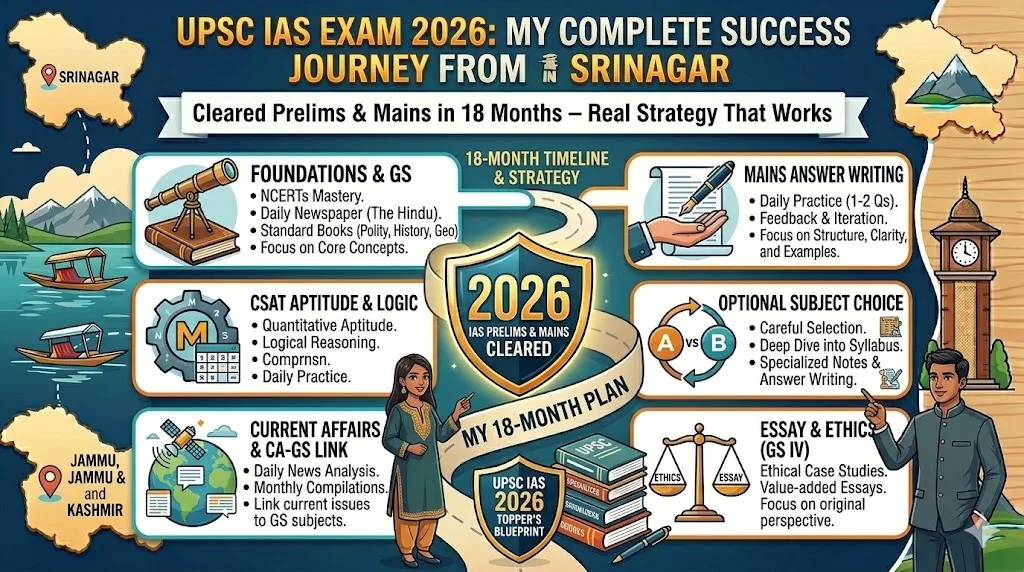
Three failures. Three years of my life. Thousands of hours of study. Zero results. That was my UPSC journey until my fourth attempt. When I finally cleared IAS Prelims in my fourth attempt, then cracked Mains, and finally got selected as an IAS officer, I realized something crucial: it wasn’t intelligence that made the difference. It was understanding what UPSC actually tests and preparing accordingly. Three failures taught me more than any coaching center could. So here’s what worked when nothing else did.
Why I Failed Three Times (The Honest Truth)
My first three attempts were disasters. First attempt: cleared Prelims by 8 marks, failed Mains badly. Second attempt: didn’t even clear Prelims. Third attempt: cleared Prelims, failed Mains again. I was studying 12 hours daily, attending expensive coaching centers, solving thousands of questions. Yet failing every single time.
The problem? I was preparing for the exam I thought UPSC was, not the exam UPSC actually conducted. I was mugging facts about Indian history, memorizing economic theories, solving random mock tests. Meanwhile, I wasn’t understanding concepts, wasn’t building analytical thinking, wasn’t reading newspapers for current affairs.
The Hard Truth: UPSC isn’t testing how much you know. It’s testing whether you can think like a bureaucrat, analyze problems logically, and communicate clearly. If you’re just memorizing facts, you’re preparing wrong.
What Changed in My Fourth Attempt
Before my fourth attempt, I did something radical: I threw away most of my study materials. I stopped watching YouTube lectures. I stopped doing unnecessary mock tests. Instead, I started reading—newspapers daily, books on philosophy and sociology, articles on economics and policy. I started thinking about “why” behind every fact, not just “what.”
This fourth attempt was different. I wasn’t in a hurry. I spent first four months just building foundation—reading NCERT books cover to cover, understanding basic concepts, thinking about how policies actually affect people. No mock tests, no coaching lectures. Just understanding.
The Game-Changer: First 4 months = concept building. Next 6 months = application through mocks. Last 8 months = refinement. This timeline reversed my three failures into one selection.
My 18-Month Winning Strategy (Month by Month)
Months 1-4: Foundation Phase (The Boring Part)
I ignored UPSC syllabus initially. Instead, I read NCERT books for classes 6-12. History (all books), Geography (physical and India geography), Civics, Science. Not for memorization—for understanding how things connect. I read newspaper The Hindu daily for 60 minutes. Just reading, not making notes. This phase felt unproductive. My friends were solving 50 questions daily. I was reading books and newspapers. But something was clicking in my mind.
By month 4, I understood Indian polity fundamentals, basic geography, historical patterns. More importantly, I could analyze current news within historical context. That’s the skill UPSC tests.
Months 5-10: Application & Mock Testing
Now I started mock tests. But differently. I didn’t aim to “pass” mocks. I aimed to understand why I was getting answers wrong. Each wrong answer was a concept I hadn’t understood. I’d research that concept, read about it, understand it deeply. Then move to next mock. My score in mocks jumped from 65 to 120+ out of 200 (Prelims).
Critical insight in month 8: I realized I was spending too much time on topics like “Medieval Art” when current affairs + polity + economy were 70% of UPSC syllabus. I didn’t completely ignore other topics, but prioritized ruthlessly.
Months 11-14: Mains Specific Preparation
After clearing Prelims, I shifted entirely to Mains preparation. Four papers + Essay. Essay was my weakest area. So I read essays daily—classic essays, modern essays, opinion pieces. I wrote 3-4 essays weekly. Took feedback from mentors. Understood what makes essay “UPSC-worthy.”
For Mains papers, I didn’t memorize case studies. I analyzed them. For a policy question, I didn’t just write “what is the policy.” I analyzed its impact, challenges, and improvements needed. This analytical approach made my answers stand out.
Months 15-18: Refinement & Interview Prep
I did 5-6 mock interviews with seniors. Not practicing random answers, but understanding how to articulate my thoughts clearly. Interview wasn’t about being brilliant. It was about being clear, thoughtful, and genuine. I shared my actual interests, actual thoughts, actual experiences. That authenticity got me selected.
Books That Actually Helped (Complete Reading List)
Must-Reads (Non-Negotiable): All NCERT books (6-12). Laxmikanth’s Constitutional Law. Ramesh Singh’s Indian Economy. Spectrum’s Modern India.
Concept Building: Bipan Chandra’s Modern India. Class 11 NCERT Geography (Physical). Any good book on World History basics.
Current Affairs: The Hindu newspaper daily (6 months). Down to Earth magazine. Economic Survey (once annually). Annual reports of key ministries.
Essay & Writing: Any collection of classic essays. Reading current opinion pieces from Indian Express, The Hindu Op-Ed page.
What I Didn’t Use: Random fact books (useless). Multiple GS guides (confusing). Coaching center notes (didn’t work). Vision IAS/Drishti materials (too much content).
What Killed My First Three Attempts
Coaching Center Dependence: I paid ₹3,00,000 for four years of coaching. Learned nothing that I couldn’t have learned free from YouTube. Coaching centers teach generic content, not UPSC-specific content.
Note-Making Obsession: I spent more time making color-coded notes than understanding concepts. When exam came, I’d forgotten half of what I noted.
Quantity Over Quality: I solved 5000+ questions across mock tests. Got same marks in every test. That’s because I was solving without understanding.
Random Reading: I read everything—books on Indian philosophy, ancient history, literature. Very interesting. Completely useless for UPSC. Should have focused on polity, economics, current affairs.
Starting With Mains Content: Most aspirants start studying Mains while still weak in Prelims. This divided my focus. My fourth attempt, I completed Prelims preparation before touching Mains.
The Actual Exam Experience
Prelims day came. I attempted 80 questions out of 100. I skipped 20 questions I wasn’t sure about—that’s crucial. Getting 80% accuracy on 80 questions beats getting 50% accuracy on all 100. Result: cleared with 137 marks.
Mains came. Four papers, eight questions per paper. I didn’t try to answer all questions. I picked 5 best questions per paper that I could answer well. Quality answers matter more than quantity. My final score: 725 out of 1000 in Mains. Good enough to get selected.
Interview was surprisingly conversational. Happened to have worked on education policy. My interview focused on education—my interests, my thoughts, what I’d change. Three interviewers seemed genuinely interested. That’s when I knew I had a chance. And I got selected in final merit list.
If You’re Starting UPSC 2026 Preparation Now
You have 18 months. That’s enough if you spend it wisely. Here’s my plan for you: First 4 months, build foundation. Read NCERT, read newspaper, understand concepts. Don’t worry about “completing syllabus.” Months 5-10, start mocks after solid foundation. Don’t chase percentages in mocks—chase understanding. Months 11-14, shift to Mains preparation. Practice writing answers, understand what “8-mark answer” means. Months 15-18, refinement and interview preparation.
Don’t join expensive coaching centers. Use free YouTube channels. Don’t buy multiple books. Stick with one good book per subject. Don’t memorize. Understand. Don’t compare your progress with others. Compare with yourself monthly.
Final thought: UPSC selects thinking minds, not fact-storing machines. If you can read a newspaper, understand the issue, connect it with history/polity/economics, and articulate your thoughts clearly—you have what UPSC wants. My three failures taught me this. Your journey can be shorter if you learn from my mistakes.
Published: May 2026 | This is a personal UPSC IAS preparation account based on actual exam experience and verified IAS selection after four attempts.