
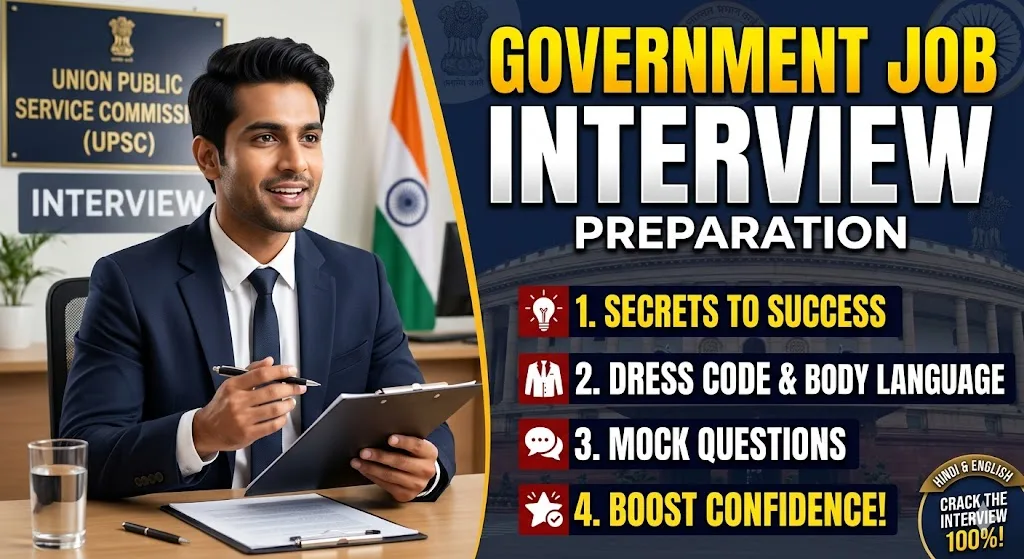
I cleared the written exam. I was confident. Then came the interview. I walked into the interview room and froze. Three senior officers asked questions I hadn’t prepared for. Personal questions. Current affairs questions. Unexpected situational questions. I answered poorly. My interview score was 35/100. I scored 95 in the written exam but failed the interview. Selection wasn’t happening. That’s when I realized: Clearing exams and clearing interviews are two completely different skills. I studied again. This time specifically for interviews. Six months later, my second attempt: Interview score was 72/100. This time I was selected. What changed? I had a strategy. This guide shares that strategy. It’s the difference between clearing the exam and actually getting the job.
Why Government Job Interviews Are Different (And Harder Than Exams)
Government interviews aren’t like corporate interviews. There’s no “tell me about yourself” and move on. Government interview is a panel of 3-5 officers. They can ask anything. They test your knowledge, personality, communication, thinking ability, integrity, decision-making, all at once. They’re not judging your answer. They’re judging YOU. Can you handle pressure? Can you think under stress? Do you have the temperament for government service?
Written exam is about knowledge. Interview is about personality. You can memorize for exams. You can’t memorize for interviews. This is why so many exam-toppers fail in interviews. They prepared for the wrong thing.
The Hard Truth: In government interviews, your knowledge matters 30%. Your personality, communication, and thinking ability matter 70%. Yet most aspirants prepare only knowledge and ignore personality.
Types of Government Interviews (Know Your Exam Type)
UPSC IAS/IPS Interview (Most Difficult)
What to Expect: 20-30 minute interview by 5-6 member panel. Questions on anything and everything. They want to assess your personality, suitability for administrative service, thinking ability, decision-making, ethical values.
Question Categories: Personal background (family, education, hobbies), Current affairs (national, international, policies), General knowledge (history, geography, science), Personality (values, integrity, conflict handling), Situational (what would you do if…).
Difficulty: Extremely difficult. No straightforward answers. They test your thinking process more than answer correctness.
SSC Interview (SI, Constable, Other Posts)
What to Expect: 10-15 minute interview. Questions on police role, law, situational handling, personal suitability for police work.
Question Categories: Why police service? Personal suitability (physical fitness, courage, integrity), Law knowledge (basic laws related to police), Situational (how would you handle a situation?), Current affairs (crime, law, governance).
Difficulty: Moderate. Questions are more straightforward than UPSC. But personality assessment is crucial.
Banking/IBPS Interview
What to Expect: 10-20 minute interview. Questions on banking knowledge, personal suitability, communication skills.
Question Categories: Banking awareness (interest rates, RBI policies, bank functions), Why banking service? Personal background, Situational (customer complaint handling), Current affairs (economic policies).
Difficulty: Easier than UPSC/SSC. More focus on communication and customer service orientation.
The Interview Preparation Framework (4 Phases)
Phase 1: Know Yourself Deeply (Week 1-2)
Government interviews always start with personal questions. They want to know who you are. Most aspirants don’t know.
Prepare answers for: Who are you? (Not name, but your character) Where are you from? (Geography and culture) Educational background? Career goals? Strengths? Weaknesses? Why government service? Hobbies? How do you relax? What books have you read? Who inspires you?
Don’t memorize answers. Instead, deeply understand yourself. Know why you do what you do. Know your real motivations. Authentic answers are always better than rehearsed answers.
Exercise: Write 10 paragraphs about yourself. Not about your achievements. About who you are. Your values. Your thinking. Your personality. Then practice speaking these aloud. This builds authenticity.
The Game-Changer: Interviewers can tell the difference between rehearsed and authentic answers instantly. They can hear when you’re speaking from heart versus when you’re reciting. Authenticity is more valuable than perfect English or perfect answers.
Phase 2: Build Domain Knowledge (Weeks 2-6)
You need to know about the job you’re applying for. UPSC officers need to know about government functioning, constitution, policies, current issues. SSC police need to know about law, police procedures, crime handling. Banking need to know about banking, RBI, financial systems.
For UPSC IAS: Read The Hindu newspaper daily. Read government websites (pib.gov.in, indianexpress.com). Understand major policies (Make in India, Digital India, GST, etc.). Know Constitution basics. Understand major current issues (climate change, unemployment, education quality, infrastructure).
For SSC Police: Read law basics (IPC sections, CrPC procedures). Understand police role. Read about current law-and-order issues. Know your state police organization. Understand police ethics.
For Banking: Read about RBI policies, interest rates, inflation. Understand major banks. Know banking terminology. Read about financial inclusion, digital payment, cybersecurity in banking.
Time Investment: 1-2 hours daily for 4-5 weeks. This should be consistent newspaper reading and understanding, not cramming.
Phase 3: Practice Under Pressure (Weeks 7-10)
Mock interviews are crucial. Without practicing under pressure, you’ll freeze in the real interview.
How to Practice: Find someone to conduct mock interviews. Ask them to ask random questions. Don’t prepare answers beforehand. Answer spontaneously. This simulates real interview conditions.
Mock Interview Format: 15-20 minute interview. 4-5 people asking questions (if possible). Questions on personal background, current affairs, job-related knowledge, situational scenarios.
Record Yourself: Record mock interviews. Watch yourself. Notice: Do you speak clearly? Do you use filler words (um, uh, like)? Do you maintain eye contact? Do you sound confident? Do you answer the question asked or go off-track?
Frequency: 1 mock interview per week minimum. 4-5 mocks before actual interview is ideal.
Phase 4: Final Refinement (Weeks 11-12)
Last 2 weeks before interview: Don’t study new things. Revise what you know. Practice breathing exercises (calm your nerves). Practice positive visualization. Build confidence.
Final Week: Light preparation only. Read newspaper. Think about possible questions. But don’t over-prepare. Freshness is more important than more knowledge at this point.
Common Government Interview Questions (Prepare Answers)
Personal Questions
Q: Tell me about yourself.
What they want: Not your CV. Your personality, values, who you are as a person.
How to answer: “I’m from [place]. I come from a [background]. I did my education in [subject]. But more importantly, I’m someone who [values/qualities]. I believe in [principle]. I’m interested in [field]. That’s why I’m here.”
Key: Keep it to 2-3 minutes. Be authentic. Focus on personality, not achievements.
Q: Why do you want to join government service?
What they want: Real motivation. Not “secure job” or “status”.
How to answer: “I want to contribute to society. I want to work on policies that impact people. I believe in serving my country. I want to be part of nation-building.”
Key: Have a genuine reason. Not fake. They’ll know if you’re lying.
Q: What are your strengths and weaknesses?
What they want: Self-awareness. Not bragging about strengths, not being too negative about weaknesses.
How to answer: Strengths: “I’m persistent. I can work under pressure. I’m a quick learner.” Weaknesses: “I sometimes get too detail-oriented which slows me down. I’m learning to balance speed and accuracy.” OR “I’m not good at public speaking. I’m working on it by joining a speaking club.”
Key: Be honest. For weaknesses, show you’re working on improvement.
Current Affairs Questions
Q: What are your views on [current issue]?
What they want: Your thinking process. Not a right answer (there isn’t one).
How to answer: “This is a complex issue. There are multiple perspectives. [Perspective 1]. [Perspective 2]. I think [your view] because [reasoning]. However, [counter-argument]. Overall, I believe [your conclusion].”
Key: Show balanced thinking. Acknowledge complexity. Present reasoning. Don’t be too assertive.
Q: What recent policy do you think is important?
How to answer: Pick a real policy (PLI scheme, National Education Policy, Digital India, etc.). Explain it briefly. Explain its importance. Show you’ve thought about it.
Key: Be specific. Not vague. Have 2-3 policies ready that you can discuss in depth.
Situational Questions
Q: A politician asks you to do something unethical. What do you do?
What they want: Your integrity, courage, decision-making.
How to answer: “I would politely refuse. I would explain why it’s unethical. If pressure continues, I would escalate to higher authority. My integrity is non-negotiable. I cannot compromise on ethics even under pressure.”
Key: Be firm on ethics. Show courage. Show you can handle pressure.
Q: You make a mistake. How would you handle it?
How to answer: “I would immediately admit the mistake. I would take responsibility. I would work on correcting it. I would figure out how to prevent it in future. I would apologize to affected parties.”
Key: Show accountability. Not defensiveness.
Interview Communication Skills (Practice These)
Speak Clearly: Articulation matters. Speak slowly. Pronounce words correctly. Avoid accent if it makes you hard to understand. Practice pronunciations of difficult words.
Avoid Filler Words: Um, uh, like, actually, basically—remove these. If you don’t know answer, pause and think. Silence is better than filler words.
Maintain Eye Contact: Look at the officer asking the question. Don’t stare uncomfortably. Natural eye contact shows confidence and honesty.
Body Language: Sit upright. Don’t slouch. Hands on table or lap. Don’t fidget. Nod occasionally. Show you’re listening. Smile naturally when appropriate.
Answer the Question Asked: Don’t go off-track. If asked “Why IAS?”, don’t explain your educational background. Answer directly. Then you can add context if needed.
Listen Completely: Let the officer finish the question. Don’t interrupt. Don’t assume what they’re asking. Sometimes the end of the question changes everything.
Practice Daily: These skills require practice. Talk to yourself in mirror. Record yourself. Join a speaking club. Talk to friends. Build communication confidence before interview.
What Kills Government Interview Performance
Mistake #1: Memorized Answers
Problem: Answers sound robotic. Officers can tell you’re reciting.
Solution: Understand, not memorize. Speak naturally.
Mistake #2: Trying Too Hard
Problem: Over-explaining answers. Using difficult words to sound intelligent. Comes across as fake.
Solution: Be simple and authentic. Clear communication beats impressive words.
Mistake #3: Lack of Confidence
Problem: Speaking too softly. Apologizing too much. Seeming uncertain.
Solution: Practice until confident. Your voice should be firm and clear.
Mistake #4: Overconfidence
Problem: Being too assertive. Not listening to others’ views. Seeming arrogant.
Solution: Be confident but humble. Show willingness to learn.
Mistake #5: Not Knowing About the Job
Problem: Can’t answer “Why this service?” convincingly. Seems unprepared.
Solution: Study the job thoroughly. Know what you’re applying for.
Mistake #6: Poor Time Management
Problem: Not leaving enough time for mock interviews. Preparing only 1-2 weeks before interview.
Solution: Start 2-3 months before interview. Consistent practice, not last-minute cramming.
Interview Day: What to Do and Not to Do
Day Before Interview
Do: Light revision. Get 8-9 hours of sleep. Relax. Do something you enjoy. Stay calm.
Don’t: Cram new information. Stay up late studying. Watch negative news. Think about possible failure.
Day of Interview
Before Interview:
Reach venue 30 minutes early. Not too early (you’ll get more nervous). Not late (you’ll rush).
Use restroom and have water. You want to be comfortable in the interview room.
Practice breathing exercises (4-4-4: Breathe in for 4, hold for 4, breathe out for 4). Calms your nerves.
Smile and greet the panel warmly. First impression matters. Handshake should be firm (not too strong, not weak).
During Interview:
Listen carefully to each question. Pause and think before answering (2-3 seconds silence is fine).
Speak clearly and confidently. Maintain eye contact. Use natural gestures.
Answer the question asked. Don’t go off-track.
If you don’t know answer: “I’m not sure, but I think…” OR “I haven’t thought about this deeply, but my initial thought is…” This is better than silence or nonsense.
If interviewer interrupts: “Okay, understood” and move on. Don’t get defensive.
After Interview:
Shake hands, smile, thank them politely. Stand and leave only when asked.
Don’t discuss interview with other candidates waiting outside. You’ll second-guess yourself and get more nervous.
Interview Evaluation Criteria (What Officers Actually Judge)
Knowledge (20%): Do you know about your field? About government? About current issues?
Communication (15%): Can you express yourself clearly? Are you easy to understand?
Personality (20%): Are you confident? Are you authentic? Do you seem genuinely interested?
Thinking Ability (20%): Can you think critically? Can you see multiple perspectives? Can you make decisions?
Integrity & Values (15%): Do you seem honest? Do you have strong values? Can you resist pressure?
Suitability for Job (10%): Would you be good at this job? Do you have the temperament for government service?
Most candidates focus on knowledge only (memorizing facts). But look at the weightage: Knowledge is only 20%. The remaining 80% is personality, thinking, integrity, communication. Yet most prepare only for the 20%.
Timeline to Interview Readiness
3 Months Before Interview: Start daily newspaper reading. Understand government functioning. Begin reading about the job.
2 Months Before: Write about yourself. Identify your values. Refine your “Why this service?” answer. Start thinking about possible questions.
6 Weeks Before: Start mock interviews. First mock might be poor. That’s okay. You’re learning.
4 Weeks Before: 2-3 mocks per week. Refine answers. Work on communication skills.
2 Weeks Before: Final round of mocks. Light revision of current affairs. Practice breathing exercises. Build confidence. Don’t add new information.
Week Before: Minimal studying. Focus on rest and mental preparation. Visualization of success.
Day Before: Light preparation. Sleep well. Stay calm.
Final truth: Government interviews test your personality more than knowledge. Yet 80% of aspirants prepare only knowledge and ignore personality. This is why many exam-toppers fail interviews. Start interview preparation immediately after you clear the exam. Don’t wait for interview date announcement. Give yourself 2-3 months. Practice mock interviews. Build communication confidence. Know yourself deeply. Be authentic. That’s the real preparation for government job interviews.
Published: May 2026 | This is a comprehensive breakdown of government job interview preparation based on actual interview experiences across UPSC, SSC, and Banking exams.