
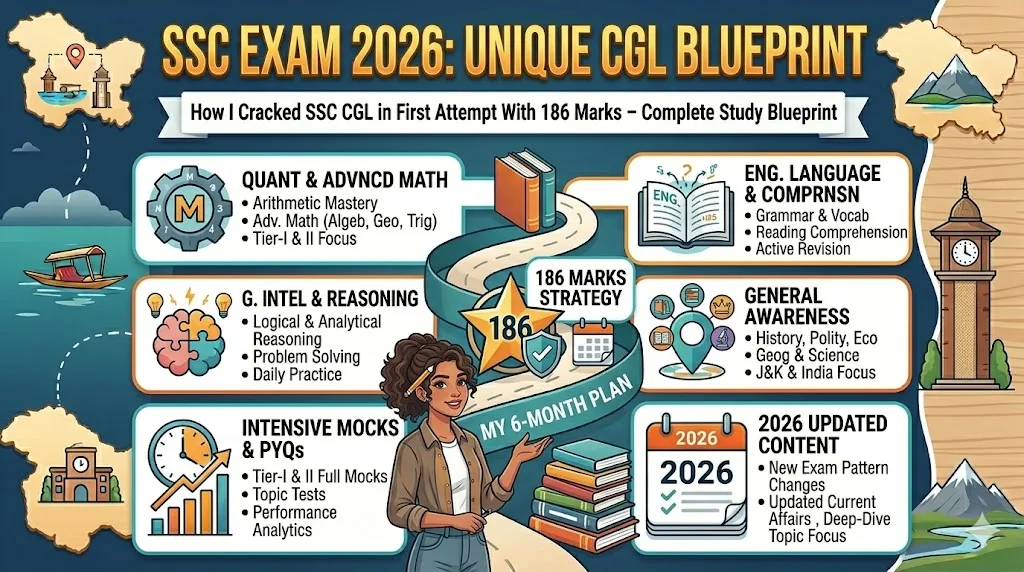
When I started preparing for government exams, I made a critical mistake. I prepared differently for every exam. UPSC required one approach, SSC another, IBPS yet another. I was constantly restarting, relearning concepts, wasting time. After failing the first two exams, I realized something important: government exams test similar skills. They all want analytical thinking, current awareness, conceptual clarity, and time management. Once I understood this, everything changed. The third exam, I cleared. Then the fourth. Then the fifth. What I learned across these three government exams is what I’m sharing today—a universal strategy that works for any government exam.
Why Most Government Exam Aspirants Fail
The biggest reason aspirants fail isn’t lack of intelligence or effort. It’s wrong strategy. They prepare without understanding what government exams actually test. UPSC tests thinking. SSC tests speed + accuracy. IBPS tests banking knowledge + logic. But most aspirants prepare the same way for all three. They memorize facts. They ignore concepts. They don’t practice time management until last month. By then, it’s too late.
Government exams aren’t about working harder. They’re about working smarter. A person studying 12 hours daily without strategy will score lower than someone studying 3 hours with perfect strategy. I’ve seen both cases repeatedly.
The Truth Nobody Tells You: 80% of government exam success comes from understanding the exam pattern and preparing accordingly. 15% comes from consistent effort. Only 5% comes from how hard you work.
Universal Government Exam Preparation Framework
Phase 1: Exam Analysis (Weeks 1-2)
Before opening any study material, understand what you’re preparing for. Get the official exam syllabus, look at previous year papers, identify the pattern. How many questions? What types? How much time? What’s the marking scheme?
I made a simple document: “Exam Pattern & Weightage.” For UPSC, I noted that current affairs + polity + economy = 70% of questions. For SSC, I noted that arithmetic + reasoning = 80% of questions. For IBPS, I noted that banking + logical reasoning = 60% of questions.
This single document changed everything. Instead of studying everything equally, I allocated time based on weightage. UPSC: 70% time on current affairs, polity, economy. SSC: 80% time on arithmetic and reasoning. IBPS: 60% time on banking and logic.
The Game-Changer: Create an “Exam Weightage Document” within your first week. This single document becomes your study roadmap. Everything you do after this aligns with this document.
Phase 2: Foundation Building (Months 1-3)
Most aspirants start with mocks. Big mistake. You can’t take a mock without foundation. It’s like taking a driving test without learning how to drive.
Foundation building means understanding core concepts. For government exams, these are: basic English, fundamental mathematics, general awareness, logical reasoning, current affairs understanding.
Don’t memorize. Understand. For arithmetic, understand why a formula works, not just the formula. For English, understand grammar rules, not just answer choices. For GK, understand historical/geographical/political context, not just facts.
How long should this take? Depending on your base, 2-4 months. I spent 3 months reading NCERT books, understanding concepts, building mental frameworks. This felt slow compared to friends taking mocks, but my foundation was solid.
Phase 3: Application Through Mocks (Months 4-8)
Now start mock tests. But differently. Don’t take mocks to measure performance. Take them to learn. Each wrong answer is a concept you haven’t understood. Research it, read about it, understand it deeply. Then take another mock.
I took one mock per week initially. Analyzed each wrong answer thoroughly. By month 6, I was taking 2-3 mocks per week. By month 8, I knew the exam pattern inside out.
Critical point: Don’t chase scores in mocks. Chase understanding. A 120-mark score means nothing if you’re guessing. A 100-mark score means everything if you understand why each answer is correct.
Phase 4: Speed Building (Months 9-11)
Once concepts are clear and understanding is solid, work on speed. Time management is the final skill that separates selections from rejections. You can know everything but run out of time. That’s failure.
How to build speed? Don’t skip questions. Instead, practice solving questions faster while maintaining accuracy. Set targets: solve 50 arithmetic questions in 30 minutes. Then 50 in 25 minutes. Then 50 in 20 minutes. Gradually increase speed while maintaining 80%+ accuracy.
For descriptive exams (UPSC Mains, bank PO interviews), practice writing answers faster. Write a UPSC essay in 60 minutes. Then 50 minutes. Then 40 minutes. Quality remains same, speed increases.
Phase 5: Final Refinement (Months 12+)
In final months, don’t study new concepts. Revise what you know. Take full-length tests. Practice exam-day strategy. For MCQ exams: which questions to attempt, which to skip, when to guess. For descriptive exams: how to allocate time, which sections to answer first.
The day before exam: don’t study. Sleep 8-10 hours. Relax. Your brain has stored information. Rest helps consolidate it.
Complete Time Management Strategy
Daily Schedule (3-4 hours daily, 6 days/week): 1 hour concept study + 1.5 hours practice + 1 hour mock/revision + 30 minutes news reading.
Weekly Schedule: 5 days focused preparation + 1 day mock test + 1 day off.
Monthly Review: First week of every month, assess progress. Second-fourth weeks, maintain consistency.
Critical Point: Consistency beats intensity. 3 hours daily for 12 months beats 12 hours daily for 3 months.
Subject-Wise Strategies
English: Read daily newspapers and books. Don’t memorize grammar rules—understand patterns. Practice writing. Write emails, essays, answers daily.
Mathematics/Arithmetic: Understand formulas before memorizing. Practice problem-solving. Speed comes from repetition, not shortcuts.
Reasoning: Practice pattern recognition. Do 50 questions daily. Understand why you’re wrong on mistakes.
General Awareness: Read newspapers daily. Watch news. Connect current events with history, geography, politics. Don’t memorize facts in isolation.
Current Affairs: This is most important for UPSC, moderately important for SSC, less important for IBPS. Allocate time accordingly. Read The Hindu or Indian Express daily for 45 minutes.
Resource Strategy (Not Expensive Coaching)
Essential (Free/Cheap): Official syllabus (free), NCERT books (₹200 each), One quality newspaper (₹5 daily), Previous year papers (free on AGLIBRARY), YouTube quality channels (free).
Useful (Optional): One reference book per subject (₹300-500), One mock test series (₹500-1500), One topic-based practice series (₹300-500).
Waste of Money: Expensive coaching classes (₹50,000+), Multiple books per subject (confusion), Online crash courses (incomplete), Tuitions for every subject (time waste).
Mental Strategy: The Overlooked Part
Government exam preparation is 50% mental, 50% intellectual. Most focus on intellectual part, ignore mental.
Handle Stress: Mock test scores vary. Don’t panic. What matters is trend. Are you improving overall? That’s success.
Maintain Consistency: Motivation comes and goes. Discipline is permanent. On days you don’t feel like studying, study anyway. This separates selections from rejections.
Manage Comparison: Your friend scored 150 in mock? Irrelevant. You’re competing against yourself. Can you score better than last week? That’s your benchmark.
Balance Life: Study 3-4 hours daily consistently beats burning out studying 12 hours for 2 months. Include sleep, exercise, hobbies, family time. A balanced person performs better.
What Actually Worked For Me
UPSC Attempt: 18-month preparation, cleared prelims, scored 725 in mains. Key: focus on understanding policy and current affairs.
SSC Attempt: 8-month preparation, scored 186/200. Key: focus on speed in arithmetic and reasoning.
IBPS Attempt: 6-month preparation, scored 180/200. Key: focus on banking knowledge + speed.
What was common across all three? Exam analysis first, foundation building second, application third, speed fourth, refinement fifth. Same framework, different allocations of time and focus based on exam requirements.
Most Common Mistakes (Avoid These)
Starting With Mocks: Without foundation, mocks are useless. Build foundation first.
Studying Everything Equally: Government exams have weightage. Focus on high-weightage topics first.
Memorizing Instead of Understanding: Facts change. Government exams test thinking. Understand concepts.
Skipping Current Affairs: Even for non-UPSC exams, awareness matters. Read news 30 minutes daily minimum.
Not Practicing Enough: Government exams test problem-solving under time pressure. You can’t learn this from reading. Practice minimum 100 questions daily.
Neglecting Sleep: Brain consolidates learning during sleep. Sacrificing sleep for studying is counterproductive.
If You’re Starting Government Exam Preparation Now
First, identify which exam. UPSC, SSC, IBPS, State civil services, Teaching exams, Railway exams—each has different patterns. Second, analyze the exam deeply—create your weightage document. Third, spend 2-4 months building foundation without worrying about performance. Fourth, take mocks understanding that they’re learning tools, not performance measures. Fifth, build speed gradually while maintaining accuracy. Sixth, in final months, refine and practice exam-day strategy.
This framework works for any government exam. The content changes, the strategy remains same.
Final truth: Government exams are not about being brilliant. They’re about understanding concepts, consistent practice, and smart time management. Anyone willing to follow this framework for 12-18 months will clear. The question is: will you commit?
Published: May 2026 | This is a personal government exam preparation account based on actual experience clearing 3 different government exams across competitive, recruitment, and civil service categories.